

In March 2017 I wrote that petrol cars would soon be “a memory” and that the future of motoring would be electric and self-driving. Nine years later, I’ve taken those predictions for a test drive. The short version: I got a lot right, one big thing wrong, and I completely missed the plot twist. Buckle up.
Electric went from curious to completely normal
In 2017, spotting an electric car was a talking point. Tesla delivered roughly 100,000 cars that year. In 2025, the world bought more than 20 million electric cars, which works out to about one in every four new cars sold, according to the International Energy Agency.
Tesla kept growing too, though the story got more interesting. It delivered 1,636,129 cars in 2025, down 8.6% on the year before. In the third quarter of 2026 it handed over 486,532, a touch below its record quarter a year earlier, but its year-to-date total is up 8.8%. The Model 3 and Model Y do almost all the heavy lifting: 478,237 of those Q3 deliveries.
The quiet hero is the battery. The average lithium-ion pack cost $108 per kilowatt-hour in 2025, down 8% in a year and 93% since 2010 in real terms. Cheaper batteries mean cheaper cars, and that’s the engine under everything else in this story.
One honest footnote: petrol isn’t “a memory” yet. Three in four new cars sold in 2025 still weren’t electric, and the United States actually slowed, with just under 10% of sales and a 45% drop in the final quarter once federal tax credits ended.
Range and charging: the worry that mostly went away
Back in 2017, range was my big caveat. A petrol car could cover 600 km or more, while electric cars were stuck around 100 km. I got excited about Tesla’s Superchargers, imagined your GPS steering you to one when the battery ran low, and even suggested that manufacturers might agree on a single plug, the way phone chargers did.
Hold on to your cables, because that’s more or less what happened. Tesla now reports more than 85,000 Supercharger stalls at over 9,000 sites, and a growing number of other carmakers have adopted its plug, known as NACS, so their cars can use the network too. The phone-charger idea is coming true, at least in North America, which is where the standard gets its name.
And charging keeps getting quicker. According to a December 2025 roundup of Chinese brands, Zeekr’s 001 can go from 10% to 80% in about seven minutes on its 900-volt platform, while NIO runs more than 4,000 stations where a battery swap takes under three minutes. Range anxiety hasn’t vanished completely, but it has gone from the headline to a footnote.
The plot twist: China
Here’s the thing I completely missed. My 2017 article was all about Tesla and Silicon Valley, and it didn’t mention China once. Oops.
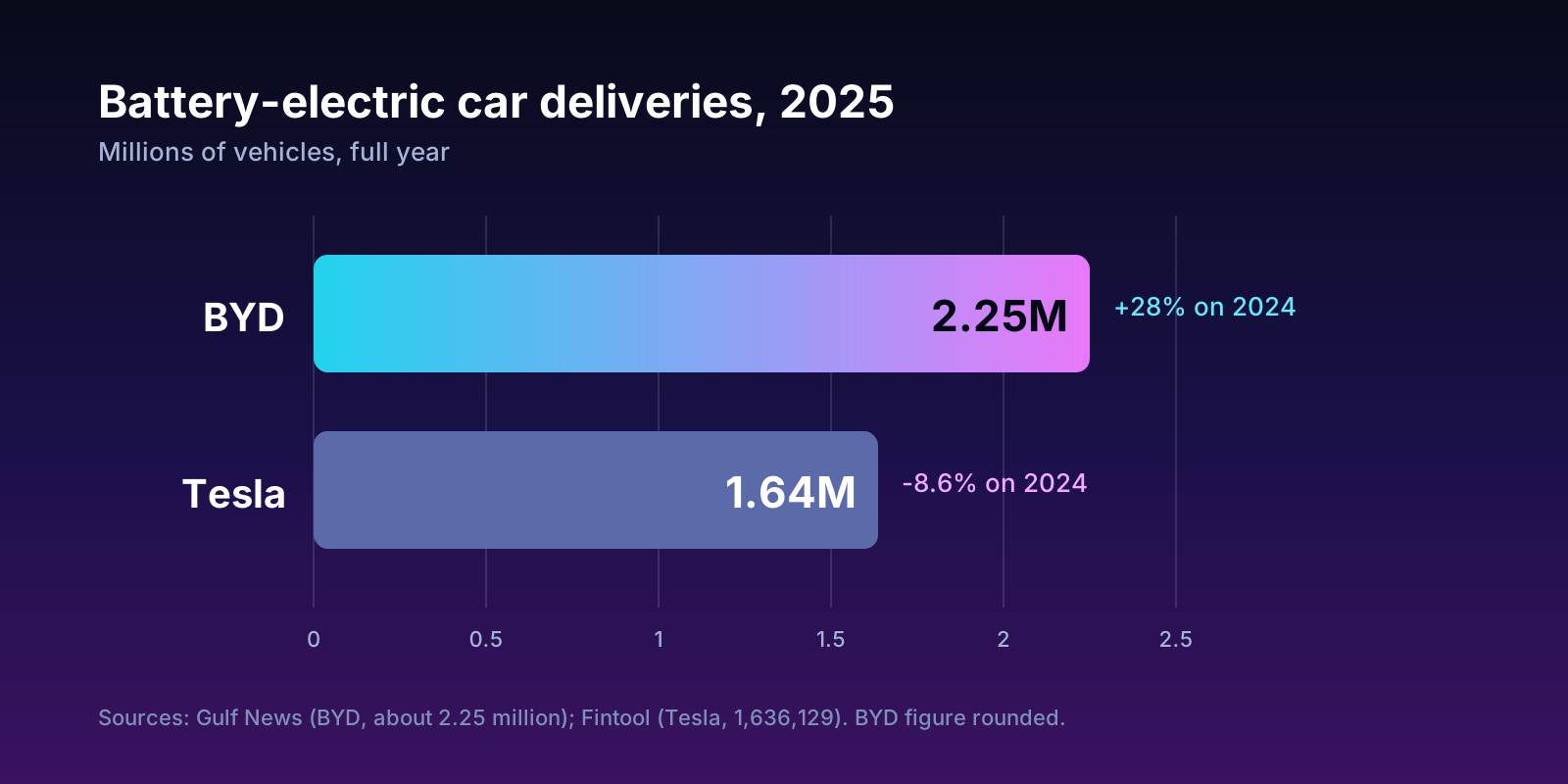
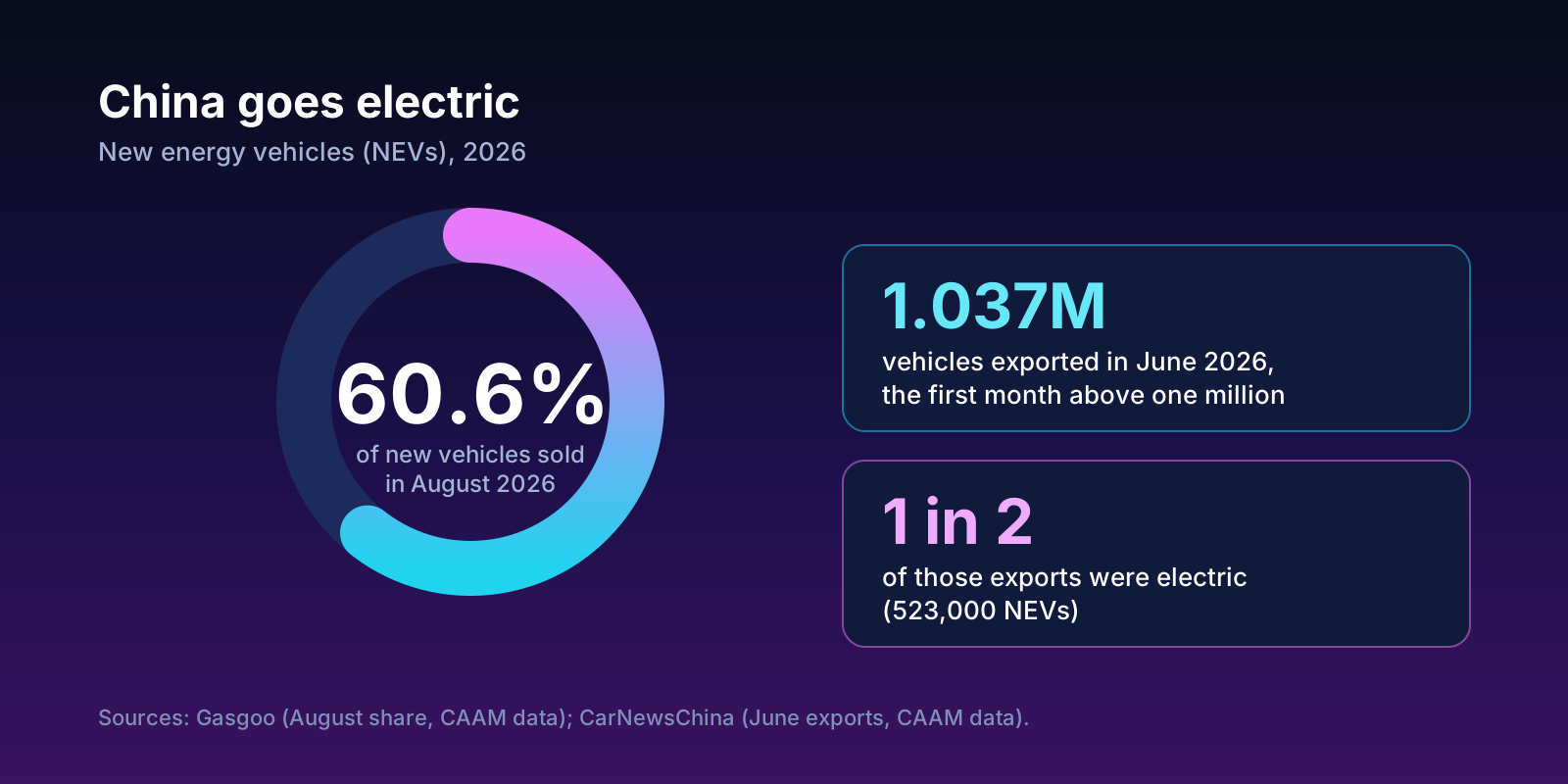
In 2025, BYD sold about 2.25 million battery-electric cars, up roughly 28%, and for the first time it out-sold Tesla to become the world’s biggest EV seller. Chinese buyers alone bought more than 13 million electric cars that year, roughly six in every ten sold anywhere, and close to 55% of new cars sold in China were electric (IEA). By August 2026 that share hit a record 60.6%, with 1.643 million new energy vehicles out of 2.712 million vehicles sold in the month.
Now they’re taking the show on the road. In June 2026, China exported more than a million vehicles in a single month for the first time (1.037 million), and more than half of them were electric. In the first half of the year, exports totalled about 5.1 million.
Meet the new names. BYD builds its own batteries, motors and chips, and has expanded production to Hungary and Brazil to sidestep tariffs. Xiaomi, yes, the phone company, sold over 200,000 SU7 sedans in under a year. XPeng’s Mona M03 is priced under $20,000. BYD’s UK sales jumped 880% in the first nine months of 2025, helped along by a plug-in hybrid SUV.
The ripple effect is already visible. Beyond China, Europe and the US, electric sales in emerging markets rose around 80% to almost 1.2 million in 2025, and in Southeast Asia nearly one in five new cars is now electric. My read: wherever you live, the best-value electric car you can buy is increasingly likely to wear a Chinese badge.
Self-driving arrived (car pools, not so much)
In 2017 I told you self-driving was developing at a “staggering” speed, with carmakers teaming up with Uber and Lyft. I also predicted we’d all end up in networked car pools, with owners earning a monthly income from sharing their cars.
The self-driving part came true, just not everywhere. Waymo now provides more than 500,000 rides a week across 14 US cities, with a fleet of over 4,000 vehicles, and it’s aiming for a million rides a week by the end of 2026.
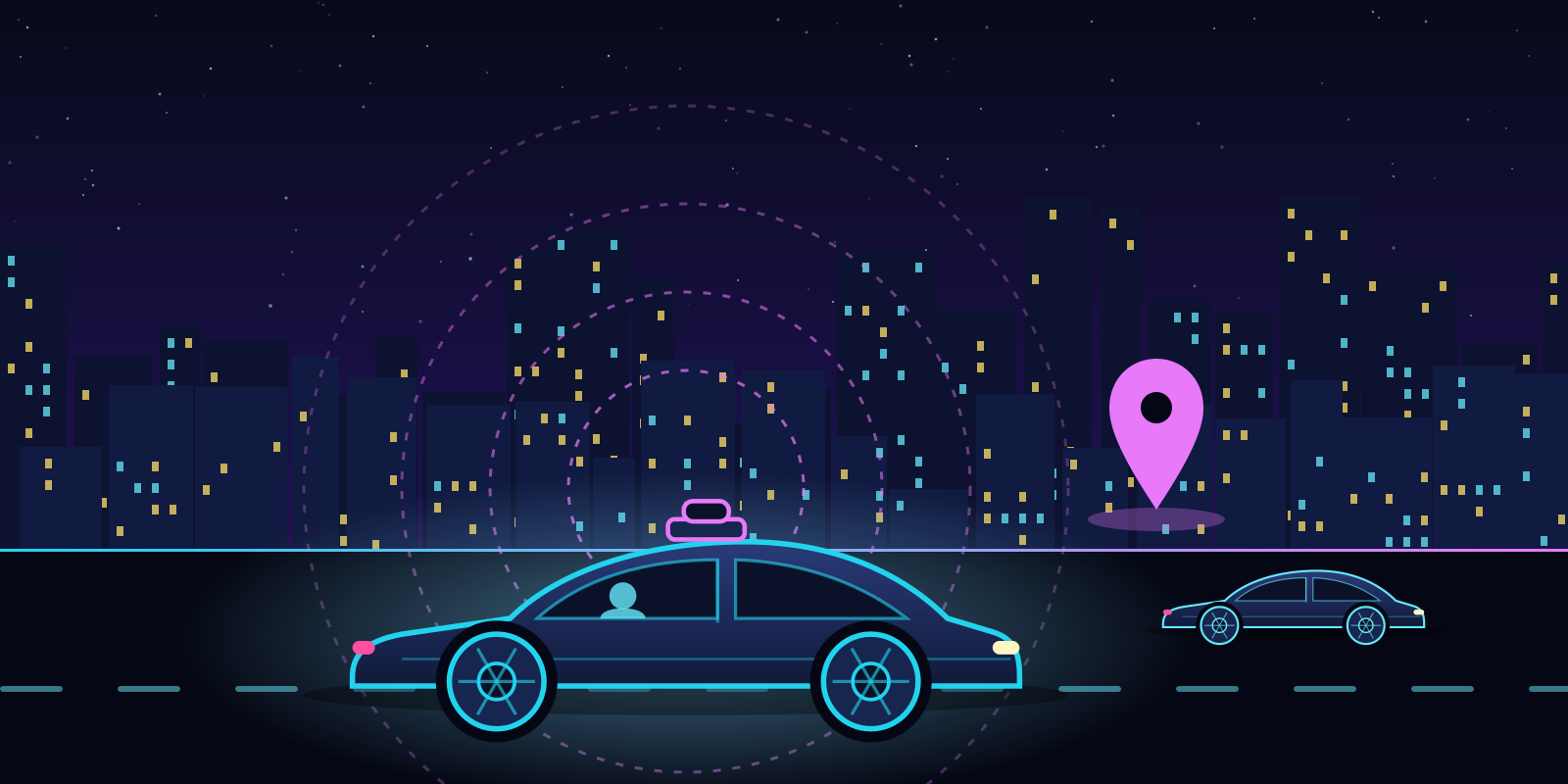
Tesla is the cautionary tale. Elon Musk repeated in May 2026 that “widespread” robotaxi service would arrive by year-end, but a late-May report counted just 20 cars running with no human on board, across Austin, Dallas and Houston, and 92 vehicles used nationwide over the previous 30 days. Tesla relies on cameras alone, while Waymo adds lidar and radar, and so far the pricier hardware is winning. Regulators are still looking into Tesla’s service, so this race is far from over.
Now the part I got wrong. Robotaxis exist, but they’re fleets owned by companies, not neighbours renting out their cars for pocket money. And most people still own and drive their own cars. Maybe my 2017 self was just nine years early.
Closer to home: South Africa’s EV story
So how is the revolution going on our side? Slower, honestly. New energy vehicles (EVs, hybrids and plug-in hybrids lumped together) made up just 2.8% of new-car sales in 2025, with 16,716 sold, up 7.1% on 2024. Across Africa, about 25,000 electric cars were sold in 2025, up from roughly 4,000 in 2023, and South Africa, Egypt and Morocco made up nearly 70% of that, per the IEA.
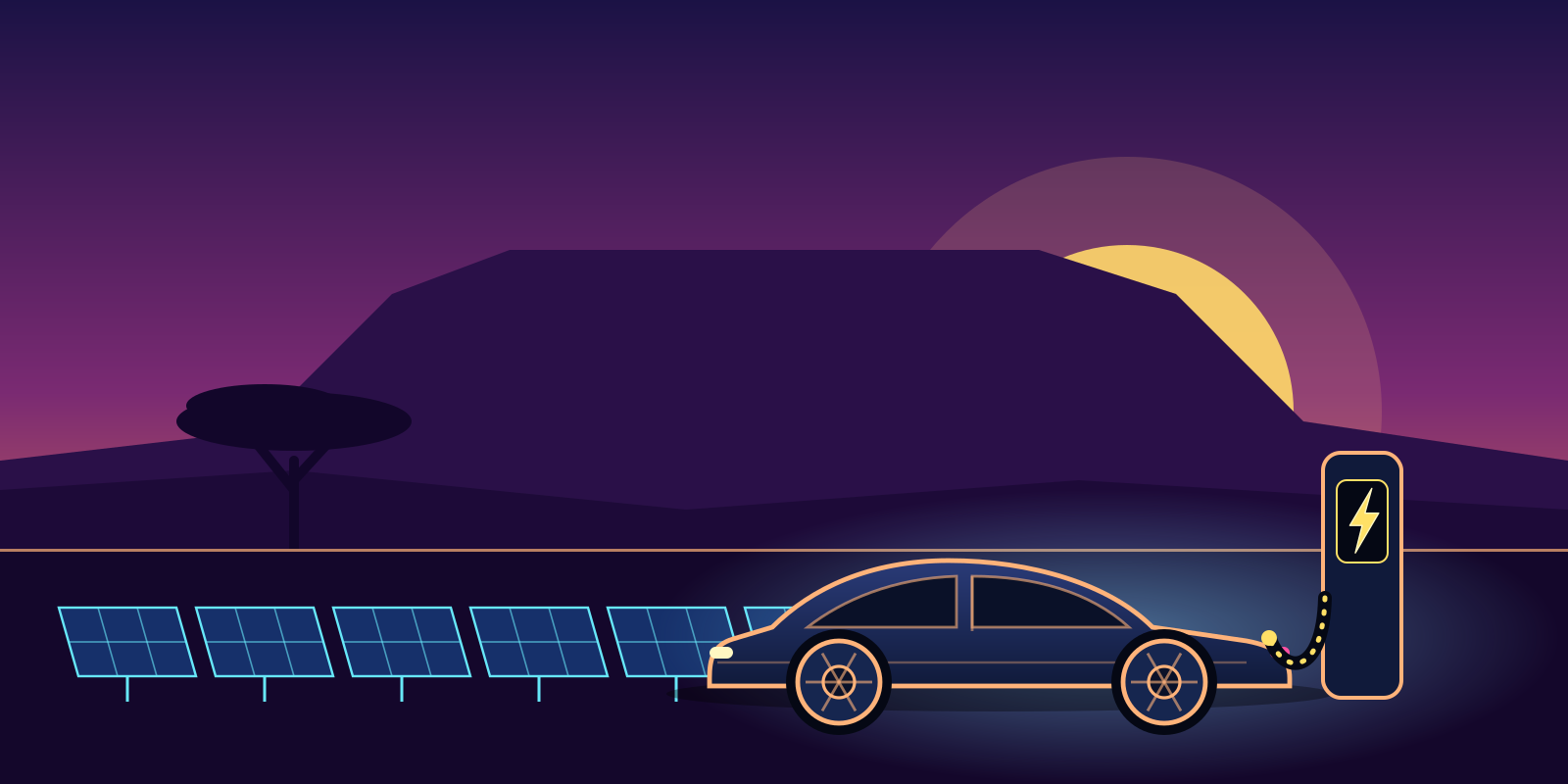
Two things are holding us back. The first is price: imported EVs face a 25% import duty, while petrol cars from the EU pay 18%. The second is charging: the network is thin, although Zero Carbon Charge is building an off-grid, solar-powered one nationwide. Industry is asking the finance minister to line up the duties and scrap the extra tax on EVs.
There are good signs. BYD said it planned to grow from 13 dealerships to 35 by 2026. And because used imports make up roughly 60% of the cars added to Africa’s roads, new-car sales probably undersell how fast things are changing. Cheaper Chinese EVs plus solar charging is a combination I think could shift the picture quickly.
The scoreboard
Here’s how each 2017 call holds up, marked the way I’d mark a mate’s homework.
| What I said in 2017 | Verdict | What actually happened |
|---|---|---|
| Petrol cars will be “a memory very soon” | Too early | One in four new cars was electric in 2025, so three in four still weren’t |
| Range is the main drawback | Mostly fixed | Battery packs cost $108/kWh in 2025, down 93% since 2010 in real terms |
| Superchargers everywhere, guided by GPS | Right | 85,000+ stalls at 9,000+ sites |
| Carmakers agree on one charging standard | Right, at least in North America | A growing number of automakers adopted Tesla’s NACS plug |
| Self-driving is moving at a “staggering” speed | Right, but uneven | Waymo gives 500,000+ rides a week; Tesla is far behind its promises |
| Car pools replace owning a car | Wrong so far | Robotaxis run as company fleets in about 14 US cities; most people still own their cars |
| (Not in my 2017 piece) China | Missed completely | Most of the world’s EVs are now sold there, and BYD out-sells Tesla |
Final score: two clean hits, three partials, one miss and one giant blind spot.
So, where does that leave the motorheads?
Nine years on, electric won the argument, China won the race, and the robots have started their first laps. The motorheads? They still have their keys, and they’re getting a lot of exciting new toys to play with.
In 2017 I called the direction right and missed who would be driving it. I’ll happily take that score. Check back in 2035 and we’ll mark my homework again.


Leave a Reply
You must be logged in to post a comment.